Most business owners know they should care about their website and SEO. Fewer can explain why in numbers that map to revenue, or which fixes actually move the needle.
This guide collects the facts that still matter in 2026: how people find you, what makes them trust or leave, and where design and SEO overlap. Every section includes data you can use in budget conversations, with charts you can reference when prioritizing work.
Search is still where buying journeys start
Before anyone calls, fills out a form, or walks into your store, they usually type a question into Google. Organic search remains the largest single discovery channel for both B2B and B2C brands, ahead of social, referrals, and direct traffic combined in many industries.

What this means for you:
- If you are not visible on page one for the searches your customers actually use, you are invisible to a large share of your market before the conversation starts.
- "Direct" traffic often includes people who heard about you elsewhere but still need your site to convert. A weak site wastes every other channel.
- Social can amplify awareness, but it rarely replaces search for high-intent queries like "emergency plumber McKinney" or "Next.js agency Dallas."
Mobile is the default screen, not a nice-to-have
Globally, roughly six in ten website visits now happen on phones. For local services, restaurants, and home services, mobile share is often 70% or higher.

Google has used mobile-first indexing for years: the mobile version of your site is what gets evaluated for ranking. A desktop-only layout that "sort of works" on a phone is not enough.
Design facts that still hold:
- 85% of adults expect a company's mobile site to be as good as or better than its desktop site (Google consumer surveys).
- 57% of users say they would not recommend a business with a poorly designed mobile site (SocPub / industry surveys).
- 48% of users interpret a non-responsive site as a sign the business does not care about them.
Responsive design is not a trend. It is a baseline ranking and credibility requirement.
Speed is a ranking factor and a revenue factor
Page speed sits at the intersection of web design and SEO. Google's Core Web Vitals (Largest Contentful Paint, Interaction to Next Paint, Cumulative Layout Shift) measure real user experience. Passing sites tend to rank better and convert better.
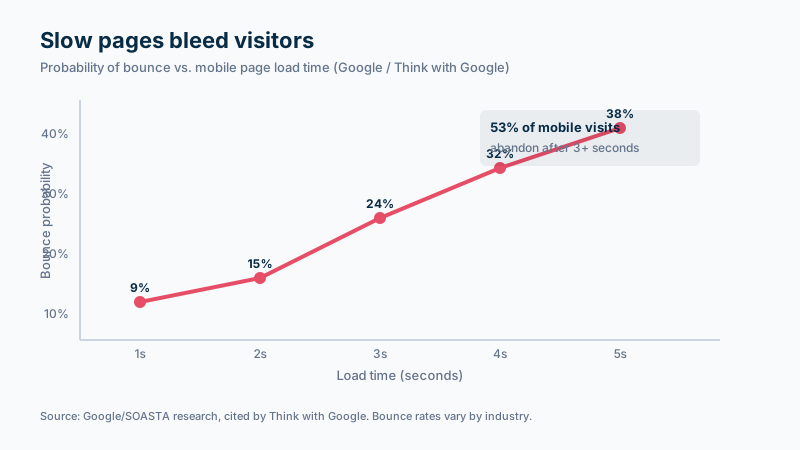
Key benchmarks from Google and Think with Google research:
| Load time (mobile) | Approx. bounce probability |
|---|---|
| 1 second | ~9% |
| 2 seconds | ~15% |
| 3 seconds | ~24% |
| 5 seconds | ~38% |
53% of mobile visits are abandoned if a page takes longer than three seconds to load. That is not a design preference; it is lost pipeline.
Common culprits we see on audits:
- Unoptimized hero images (often 2–5 MB PNGs on the homepage)
- Render-blocking scripts from legacy WordPress plugins
- Third-party widgets (chat, reviews, heatmaps) loaded before main content
- No CDN or edge caching for static assets
Modern stacks (Next.js on Cloudflare, optimized images, font subsetting) exist precisely because speed is measurable and competitive.
Local search: high intent, fast decisions
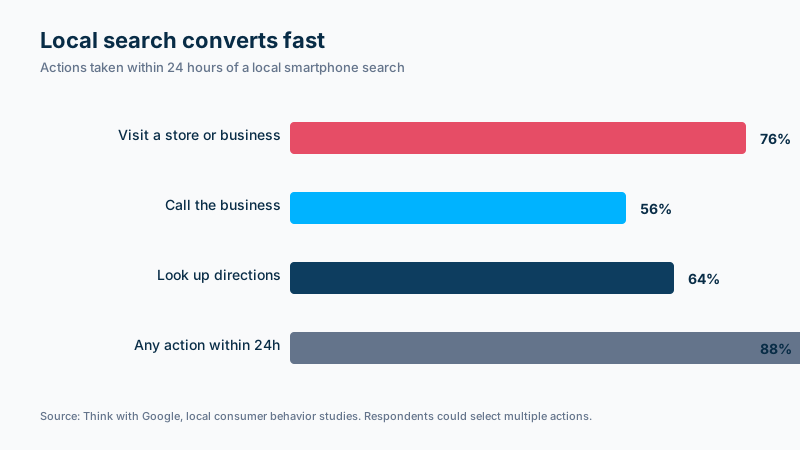
If you serve a geographic area, local SEO is not optional. 46% of Google searches have local intent. 76% of people who search for something nearby on their smartphone visit a related business within 24 hours.
Your Google Business Profile, NAP consistency (name, address, phone), and location pages matter. But so does the site people land on after they tap your listing:
- Click-to-call buttons above the fold on mobile
- Service area and hours visible without scrolling
- Fast load on cellular networks (not just office Wi‑Fi)
- Real photos, not stock imagery, on location and service pages
A beautiful site that hides your phone number behind three menu taps loses to a plain site that loads in one second and has a sticky "Call now" button.
Design drives trust before anyone reads a word
Stanford's Web Credibility Project found that 75% of users judge a company's credibility based on website design alone. People decide whether to stay in 50 milliseconds (Lindgaard et al., Behaviour & Information Technology).
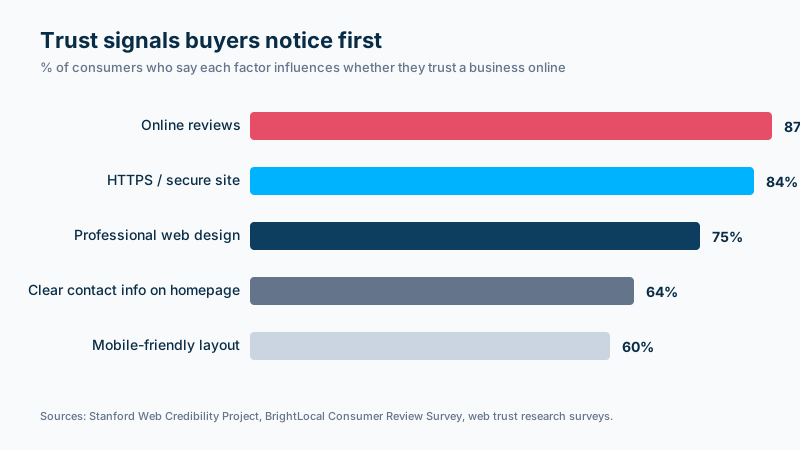
Trust signals that show up in repeated consumer surveys:
- 87% read online reviews for local businesses (BrightLocal)
- 84% will abandon a purchase if the site is not secure (HTTPS)
- 64% want contact information on the homepage
- 48% say design is the top factor in judging business credibility
SSL/HTTPS is both a trust badge and a ranking signal. Encrypted pages often load faster on modern HTTP/2 and HTTP/3 connections as well.
Layout facts from eye-tracking research (Nielsen Norman Group):
- Users spend 80% of their time viewing the left half of a page on desktop.
- 66% of attention goes below the fold; people scroll, but the hero still sets the first impression.
- Scannable headings and short paragraphs outperform walls of text for both engagement and SEO featured snippets.
SEO pays back over time; paid ads stop when you stop paying
Organic SEO typically delivers a lower cost per lead than paid search over a 12–24 month horizon because content and technical fixes keep working after the initial investment.
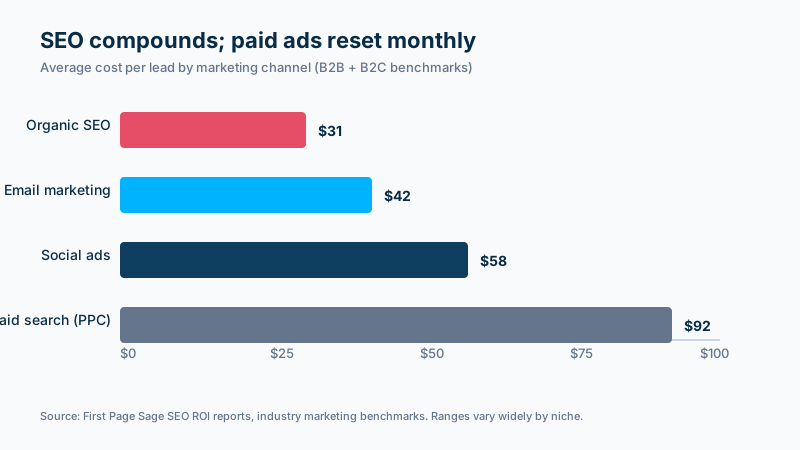
This does not mean "SEO is free." It means:
- A well-built site with solid technical SEO reduces ongoing ad spend for the same lead volume.
- Content that ranks for informational queries feeds the top of the funnel while service pages capture bottom-funnel intent.
- Regular optimization compounds: sites that publish and refine content see traffic lifts of 100%+ over 12 months in many verticals (Ahrefs and industry aggregate studies).
Paid search still has a role for launches, promotions, and keywords you cannot rank for yet. The mistake is treating ads as a substitute for a site Google can crawl, index, and trust.
20 facts worth printing for your next planning meeting
- 68% of online experiences begin with a search engine (BrightEdge).
- 63% of global web traffic is mobile (StatCounter).
- 53% of mobile users leave a site that loads in more than 3 seconds (Google).
- 46% of Google searches have local intent (GoGulf / industry aggregates).
- 76% of local mobile searchers visit a business within 24 hours (Think with Google).
- 75% of users judge credibility by website design (Stanford).
- 87% of consumers read online reviews for local businesses (BrightLocal).
- 64% want contact info on your homepage (KoMarketing and UX research surveys).
- 57% will not recommend a business with a poor mobile site (SocPub).
- 88% of local mobile searches result in a call or visit within 24 hours (Nucleus Research, cited by Google).
- HTTPS sites are preferred by browsers and search engines; Chrome labels HTTP forms as "Not Secure."
- Core Web Vitals affect ranking; passing all three correlates with better average positions in large-scale studies (Moz, SISTRIX).
- First input delay / INP matters: sluggish buttons after load still hurt rankings and conversions.
- Featured snippets and "People also ask" boxes now appear on a majority of informational queries; structured content wins them.
- Video on landing pages can increase conversions, but autoplay video often hurts LCP and mobile data users.
- Schema markup (LocalBusiness, FAQ, Service) improves rich results eligibility; it is not a ranking guarantee but increases SERP real estate.
- Internal linking distributes authority; orphan pages rarely rank.
- Duplicate content from www/non-www or HTTP/HTTPS splits signals; pick one canonical version.
- WordPress still powers roughly 43% of the web (W3Techs), but plugin bloat is a leading cause of slow local business sites.
- 100% of websites can improve. The question is whether improvements are prioritized by impact or by whoever shouted loudest in the last meeting.
How design and SEO decisions stack together
Use this priority matrix when budget is limited:
| Priority | Fix | Design impact | SEO impact |
|---|---|---|---|
| 1 | Mobile layout + tap-to-call | High | High |
| 2 | Core Web Vitals (LCP, INP, CLS) | High | High |
| 3 | HTTPS + clean URL structure | Medium | High |
| 4 | Clear service pages with unique copy | High | High |
| 5 | Google Business Profile + local schema | Medium | High (local) |
| 6 | Blog / help content for long-tail queries | Medium | Medium (compounds) |
| 7 | Visual refresh / rebrand | High | Low short-term |
Rows 1–5 are table stakes. Row 6 builds moat. Row 7 is worth doing, but not before the site is fast, findable, and trustworthy.
What to do this quarter
You do not need a 50-page audit to start. A focused 90-day plan looks like this:
Month 1 — Measure
- Run PageSpeed Insights and Google Search Console on your top 10 URLs.
- Record mobile vs. desktop traffic split in GA4.
- List your top 20 queries and average position.
Month 2 — Fix foundations
- Compress images, enable CDN/edge caching, remove unused scripts.
- Add or fix contact info, HTTPS, and mobile navigation.
- Claim and complete Google Business Profile if local.
Month 3 — Grow
- Publish or refresh two service pages targeting high-intent keywords.
- Add FAQ schema to pages that answer real customer questions.
- Build internal links from blog or help content to money pages.
Sources and further reading
- Think with Google — Mobile page speed
- StatCounter GlobalStats — Platform share
- BrightLocal — Local Consumer Review Survey
- Stanford Web Credibility Project
- Google Search Central — Core Web Vitals
- Nielsen Norman Group — F-pattern and scrolling behavior
- W3Techs — WordPress market share
Originally published April 2019. Updated May 2026 with current benchmarks, charts, and a prioritized action framework.